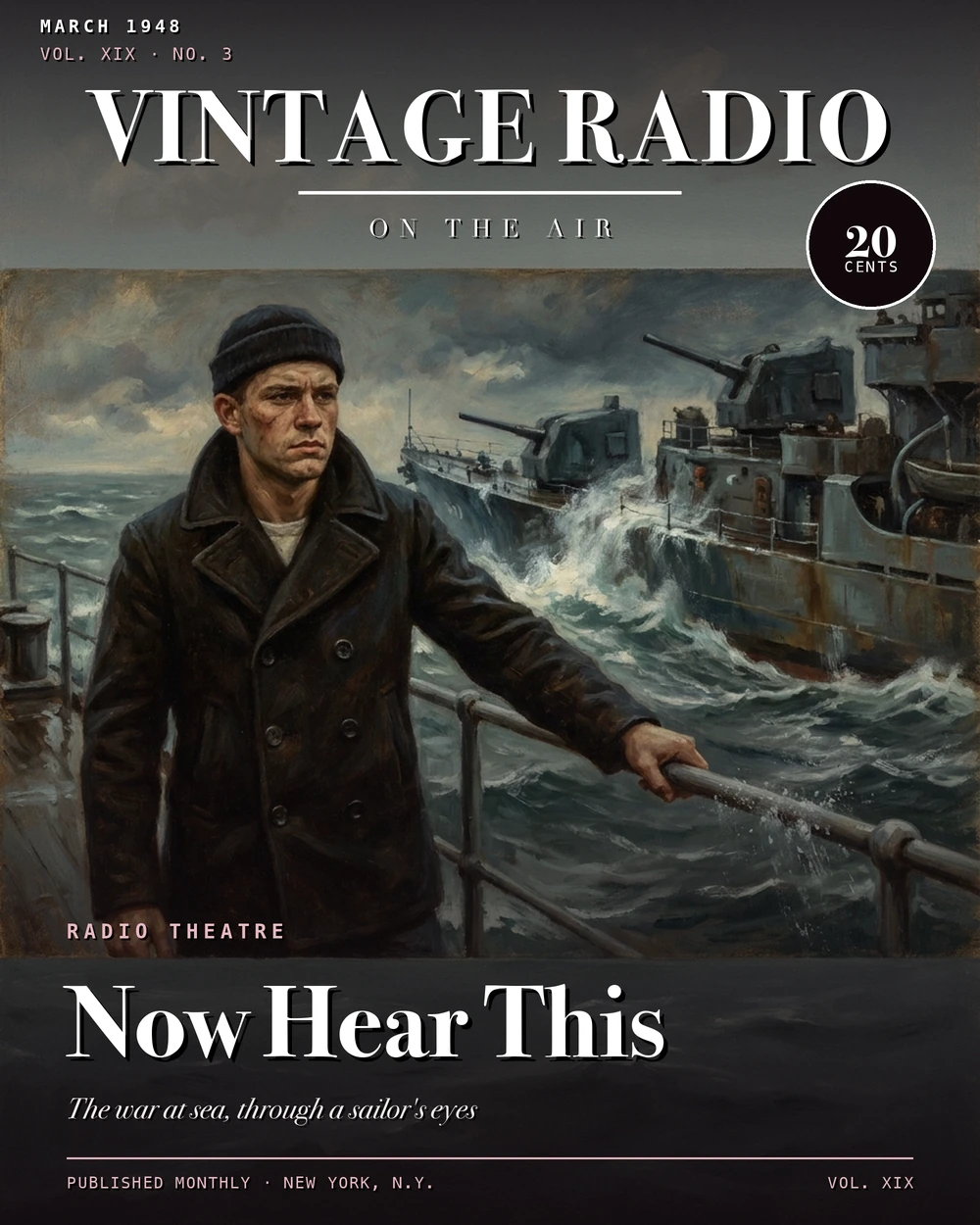
Now Hear This
What the Show Was
Now Hear This ran on NBC on Sunday afternoons at 5:30, from June 24 to November 4, 1951 — about twenty weeks of half-hour drama produced in cooperation with the Navy Recruiting Service. The title came straight from naval tradition: before passing orders over a ship's 1MC public address system, the bosun's mate of the watch would blow a pipe and say "Now hear this…" NBC and the Navy Recruiting Service adopted the phrase as the show's name, and the opening of every episode made the reference literal — a sharp blast of a bosun's pipe, followed by the orders of the day. The closing mirrored it, with the bosun calling "all hands secure until 1730 next Sunday."
The show's stated purpose was to encourage young men and women to enlist in the Navy. Stories drew on both World War II and Korean War–era service, with most episodes set in what the show itself called "the dirty days of the early war." Subjects ranged from marine landings and PT boats to underwater demolition teams, Seabees in action, and the war in the Aleutians. The premise, as the show put it, was "dramatic stories based on the personal experiences of those gallant men and women who embody the great traditions of a great service — the United States Navy." The theme music was "Anchors Aweigh."
The Enlisted Man's View
What separated Now Hear This from other Navy-themed radio dramas of the period was its point of view. The narrator was not an officer. He was Boats — a rugged old Chief Boatswain's Mate with thirty years at sea, gruff and plain-spoken, with no patience for ceremony and a working sailor's perspective on everything he described. The character cut through the brass-and-bunting version of Navy life and told the stories from the deck plates up.
The show could get a little fantastical in spots, but it consistently captured something real about enlisted service: the frustrations of long deployments, the loyalty men felt toward their ships and crewmates, the particular texture of doing hard work in difficult places. One episode puts a submarine crew aboard the USS Barracuda en route to the Philippines on the morning of December 7, 1941, as three Japanese destroyers close in after the Pearl Harbor attack begins. Another follows a sailor who discovers his younger brother — a Marine — is on the same troop transport heading for Guadalcanal.
The Cast
Two, and possibly three, actors shared the role of Boats across the run. Larry Haines and Arnold Robertson are both identified with the part, and Jackson Beck is listed in some research logs as having played the narrator as well.
Haines — born Larry Hecht on August 3, 1918, in Mount Vernon, New York — came to Now Hear This already deep into a prolific radio career. It was estimated he acted in more than 15,000 radio programs during the 1940s and 1950s, having started at small New York station WWRL after dropping out of college in his sophomore year. His post-radio work was notably varied: he played neighbor Stu Bergman on the soap opera Search for Tomorrow for 35 years, from 1951 to 1986, winning Daytime Emmy Awards in 1976 and 1981. He picked up two Tony Award nominations — for Generation in 1966 and Promises, Promises in 1969, with New York Times critic Clive Barnes calling his work in the latter "beautifully judged." He originated the role of Speed in the Broadway production of The Odd Couple in 1965 and reprised it in the 1968 film. He died July 17, 2008, in Delray Beach, Florida, at 89.
Arnold Robertson, born January 22, 1911, in Chicago, had television credits including I Spy and The Ford Theatre Hour. He died July 23, 1969, in Queens, New York. Jackson Beck, born July 23, 1912, in New York City, was best known as the announcer and narrator of The Adventures of Superman radio series starting in 1943, and as the voice of Bluto in the Famous Studios Popeye theatrical cartoons. He had started in radio in 1931 at WINS and WHN, was a founding member of the American Federation of Radio Artists, received a star on the Hollywood Walk of Fame in 1984, and was inducted into the National Radio Hall of Fame in 1999. He died of a stroke on July 28, 2004, five days after his 92nd birthday, in Manhattan.
The supporting cast was drawn from the New York radio acting pool and included Jack Grimes, James McCallion, Bill Quinn, Maurice Tarplin, Bob Readick, and a long roster of others. Jack Costello announced. David Harmon wrote and directed. Chick Vincent and Sy Levine produced.
The Run
Now Hear This wrapped after about twenty episodes in November 1951. Twenty episodes survive, running close to thirty minutes each — nearly ten hours of audio in total. The surviving titles track closely with the story subjects the show set out to cover: "Marine Landing," "Underwater Demolition Team," "Aleutian Islands," "Seabees in Action," "PT Boats," "Operation Submarine." It was a short run with a narrow brief, but within that brief it worked through the range of naval service it promised from the start.